Friday, 21 December 2007

R is for RENT

It was ten storeys high but everyone had their own story. In my three years imprisoned within its walls, I had lived on three different floors but had never reached either the top or the bottom. There was only one entry door that opened onto a communal living room with arm chairs that had obviously been bought in bulk and not the sort that you would entertain in your own house. The warden lived on this floor and there was a little counter with a bell where you could contact him if necessary and just across the way, two public telephones that, in the evenings, were constantly in use, since the mobile was still some years away from making its appearance. The only other areas of interest on the ground floor were the lifts doors that almost everyone used, the door leading to the stairs that only the energetic or those living on the lower floors ventured through and a little dark corridor that led to a television room capable of accommodating about twelve of the one hundred and fifty or so inmates. Each level above was more or less self contained and looked identical. There was a central kitchen area that looked out over a small lake and on the higher floors, offered panoramic views over part of the city but it was never busy and more likely to be only used regularly by students who lived there on a more semi-permanent basis that those of us who disappeared at the weekend. Each room inside also followed a similar pattern, with a bed, chair and desk all acquired from the same supplier as the living room chairs and a little wash corner that housed a basin and a few shelves. But this was no en-suite for toilet, bath and shower facilities were communal, though even you never really got to know your neighbours. It was basic, but for three years of university life it was adequate so I paid the rent and just got on with it.


By fourth year, we were all ready for a change and despite the view of Belfast from our kitchen window we opted for a view of a side street filled with parked cars and our first attempt at running a house. IN two years, I live in two different rooms, first in a small room on the middle storey that looked out over a small and cramped back yard, hardly the most stimulating scene in the city. We tried to live as a family, cooking for each other and sharing a living room downstairs and while the system worked for the year, we were hardly all blood relatives and generally lived single and separate lives within the family unit. But I think we all learned to cook there and also gained some valuable experience in the less closeted environment of a terrace house. In my last year, when most of the house mates had changed, I acquired the room on the top floor. It was the biggest room and provided a panoramic view of about thirty metres of street and a bank training centre directly opposite but it wasn't a scene to die for. The room itself had a bed, a table that became my desk and a wardrobe that doubled as a clothes hanger and a dump for the discarded daily papers I bought. On the thin mantle piece, was perched my record player that would have sat uncomfortably beside any average hi-fi system but it made a sound and though it probably ruined most of the vinyls that were unfortunate enough to grace its turntable, it made a sound and that was enough to appease a student now trying to fund a car and pay the rent. However, being at the top is not all sunshine and the room always had a smoky feel to it, no doubt caused by the fumes that would drift in from neighbouring houses in an area that was still not smokeless. I lived a more solitary existence in that room, and probably spent as much time at away from it as in it so I never really made it home at all, to the extent that my only bed covering for most of the year was inside a sleeping bag. But I still paid the rent and got on with it.


For three summers I returned home and lived a rent free existence before we got married and then moved into a corner house that we rented for a further period of three years. The rent was ridiculously cheap and though the house had its problems, it was a lovely old building and as tenants and newly weds, we were happy to live there until something more permanent appeared. In winter it was a cold house, but not cold enough to ward off frequent small visitors with long tails and we essentially lived in about three or four rooms, again on three storeys. At the front there was a small but adequate mature garden, with several trees and at the rear, a sizeable yard with outbuildings that the owner rented out to other neighbours, so we were never alone. However, as plans for our own house became more than just drawings on paper, we found ourselves spending less and less time in the rented accommodation and most of our waking hours, painting, decorating and overseeing the new building. I wasn't sorry to leave the corner house but we had many happy memories in our three or four rooms and we always paid the rent, though we were always looking forward to our new home.


And we are still looking forward to our new home, the one that Jesus has gone to get ready, for he left his disciples with this promise,'In my Father's house are many rooms; if it were not so, I would have told you. I am going there to prepare a place for you.' But we have to be ready for the move and have made our own preparations for when he returns to take us there. That means trusting in the One who said He will return. In all the place I have lived, I have never wanted to move back to the previous place, because I know that where I am, it is better than before. And that's the way I still think, knowing that what Jesus has prepared for me is far better than anything I have here. In the week that we remember Him making His temporary home on earth, let's make plans for a more permanent dwelling where we never have to pay to stay for ever.

Thursday, 20 December 2007

R is for RUTH

Don't you just adore a good love story. Something that puts 'Gone with the Wind' well into second place. A real tear jerker. One of those 'happy ever after' tales that just leaves you with that good feeling in the pit of your stomach and a smile on your face. Ruth's story is just like that. I think it's my favourite story in the whole of the Bible, so much so in fact, that a few years ago we made a video about it in school with some of the children and when we watched it the other day, apart from the fact that we all look older now, we were pleasantly surprised with our efforts. But more than that, I think we began to remember just how more it is than just an extraordinary love story. So, first, for all of you who have forgotten or never knew, here's a quick review.

Elimelech, Naomi and their two sons, Mahlon and Kilion, leave Bethlehem and go to live in Moab, because of a famine. Nothing too strange there. While they are there, dad dies and leaves Naomi a widow but her two sons marry a couple of girls from Moab, called Ruth and Orpah and they almost live happily ever after, except that both of the boys die, leaving their mum in a strange country with two daughters in law whom she hardly knows and a culture and religion very different to the one she left in Bethlehem. Like any sensible person, the distraught Naomi decided to go back home, since she has no longer any reason to stay there and after trying to persuade her relatives by marriage to stay in their own country, get married again and get on with their lives, she realises that Ruth is determined to accompany her mother in law back to Bethlehem and live with her there.

Obviously they need money to live and it just happens that they arrive back at harvest time and Ruth goes to work in the fields. It just seems too much of a coincidence but the field she ends up working in belongs to a guy called Boaz who just happens to be a relative of Elimelech, her father in law. Anyway, to cut a long story short, he falls in love with her, makes sure she gets plenty of food and drink and generally takes a real interest in her well being. Naomi realises what's happening and before Ruth has time to draw breath, has everything set up for the romance to blossom even further. It's almost a bit like Valentine's Day because in effect, Ruth just about asks Boaz if she can be his wife. He's obviously keen but because of some ancient rules, he can only marry her if he is the closest relative, which, unfortunately, he isn't! Anyway he gets around that problem by talking to the relative and in a strange custom a sandal is exchanged in much the same way as we would shake hands on a deal nowadays.

Some time after that, Boaz and Ruth marry, they have a son whom they call Obed and they all live happily ever after. But here's the catch. It's not a story at all, it's not even a fictional account of some true life events. It is in fact true. When I was young I often wondered why the Bible needed to have such a lovely story apart from the obvious pleasure it brought to its readers. Then I began to delve more deeply, knowing like everything else, it was there for a reason. The answer comes in the family tree, for Ruth's son, Obed, was the grandfather of David,the second King of Israel and the great Psalm writer and of course, Jesus, in human terms, is a direct descendant of that great King and born in the very town where Ruth and Boaz lived so many years before. The angel tells it all to the young Mary when he says 'The Lord God will give him the throne of his father David, and he will reign over the house of Jacob for ever; his kingdom will never end.' And of course it never will for the God who had his hand on uniting a rich man from Bethlehem with a young widow from Moab, wasn't just thinking about a King who would rule Israel for a few years but of a King who would rule the world for ever and restore the broken relationship with his ultimate creation. And that is the ultimate love story!

Wednesday, 19 December 2007

R is for RECORDER

I bought it from a guy who only live about nine miles away from me but whom I never knew until we went to university together. Even then he was really only an acquaintance but happened to be an acquaintance with something that I liked. I should say that covet is probably the wrong word to use here but the thought had crossed my mind that it mightn't be so far off the mark. He was into hi-fi in a big way. I hadn't even knocked the door. But someone told me that he might have a tape recorder for sale. Not just an ordinary tape recorder but a big upright one that held tow large reels and was the closest thing to having a recording studio that existed. He used it for making recordings of his albums so as not to have to play the vinyl discs and preserve their quality while listening in perfect stereo to the big recorder. But he just didn't see the potential in the machine, probably because he wasn't interested in playing music in an instrument sort of way. I had researched for months how to be able to record more than one instrument playing a piece of music and so sound like a one man band and all roads had only led me to one affordable solution, the Akai 4000 and suddenly it lay directly in my path, though someone else was still holding it! It didn't take much persuasion to make a student part with a peripheral possession for about £100 and I didn't need any time to make a decision either.

It was a great buy, though not the Rolls Royce of recorders at the time, it lay somewhere neatly below a Teac reel recorder and far above the old Marconi recorder that lay underneath the record player in our good room. Still, it was beast and not portable in an ipod sort of way, being about the size of the average computer tower but the weight of an a 32 inch television. However, for years it did the job and the beauty of it was that even though it recorded on two tracks, you could either record them separately and make a beautiful stereo picture or you could record on just one track and 'bounce' it to the other channel while adding a second instrument. For months that was how I spent much of my spare time, experimenting with different instruments and voices and building up the whole thing until I sounded like a full band. However there were drawbacks, the main one being that every time a track was bounced, the quality of the new track was not as good but the amount of tape hiss increased. By the time I had completed six or seven bounces, the track and the hiss were in direct competition for my attention and there certainly wasn't any clarity in the recording. But I kept them and in retrospect I now see just what an important learning experience the whole thing became and while the sound quality was never anything other than mediocre, the music quality began to improve the more I played and even now some of those old recordings hold a special place in my heart.

Richard was an expert in recording and on several Sunday afternoons he and I would meet up in our living room and attempt to make our own particular version of a song. We were always full of good intentions but when we sat down to it, we could never think what song to record so we ended up with such classics as 'I'll fly away' and the old Kristofferson hit 'Help me'. The quality was so much better for two reasons. First, Richard knew what he was doing and secondly we just played live and never bounced any tracks. But I learnt form such a master and got better. HE went on to work for the BBC and though illness claimed his life very early, I was always thankful that he had crossed my path and showed me the way.

You know I don't consider myself anything special, especially when I look at the great men of faith in Bible times and even in our modern day. I don't even consider myself special in my achievements compared to those who have become successful entrepreneurs, politicians or enterprising businessmen. I'm not the Rolls Royce of human beings in any field but thankfully in God's eyes, I am every bit as special as any other human being. What a lovely thought to cherish. So I look at what He has given me and I try to utilise that as best I can and in the way I think He would want me to do so. And I'm thankful that even amidst the hiss of everything else that surrounds my life, He can still hear and see me loud and clear and is pleased with what He sees. I'm thankful too that he has directed many individuals along my way so that I can learn from them and be more successful for Him and I'm thankful more than anything that I took that step, even when I knew so little and asked Him to be my Saviour.

I never use the Akai reel recorder any more. I've moved on to other devices as my knowledge and experience have increased and as man's technology has improved but that grounding has never left me. At this Christmas time, as we hear so much negativity about the offence that the Nativity might cause to others, never forget those words from Ecclesiastes, 'Remember your Creator in the days of your youth, before the days of trouble come and the years approach when you will say, I find no pleasure in them.' Remember it's not the life that you have but what you do with it!

R is for RAWHIDE

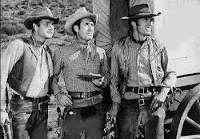
It was the first time I had seen Clint Eastwood, but I hadn't a clue who he was. I only knew him as Rowdy Yates. HE was a sort of assistant to Gil Favor who was the boss of what seemed like a continuous cattle drive across America that never started or ended anywhere. Along the way, they encountered all sorts of problems, some of their own making but by the time the hour was up, everything was solved and the cowboys were back up on their horses and responding to Mr Favor's catchphrase 'Move 'em up and head 'em out!' By the end of 1966 they had all headed out after over 200 black and white episodes, most of which I had probably seen but none of which I can remember. Rowdy would soon become the man with no name for quite a few dollars more and Gil alias Eric Fleming would drown during other filming.
It wasn't the only western type programme that the BBC managed to acquire from across the big pond and I was an avid watcher of them all. Wagon Train overlapped Rawhide for years, though it ran to slightly more episodes. The plot was similar, except instead of driving cattle across America, the drove lots of covered wagons. Its hero was Major Seth Adams played by Ward Bond who died halfway through the fourth series but I always remember Coop because the actor who played him had also been a star of Laramie and spoke with the most beautiful American drawl that you can imagine. He played a drifter called Jess Harper and the show lasted for only about four years.

However, long before I even got hooked on that, I'd been glued to the old black and white set, watching Roy Rodgers and Trigger and even though there was no colour, I always imagined the horse as golden though truthfully I never looked forward to Roy's little sing song at the end. It just made the whole thing a bit unreal, 'happy trails' and all that. Around that time, like most kids my age, I was in awe of the masked man, his Indian friend and their two horses, Silver and Scout. 'Who is that masked man?' people would ask and though I hadn't a clue myself, I never thought about his past, only his present and the good that he was doing. In later years I discovered that the Lone Ranger's mask had been made from the vest of his murdered brother and but for the appearance of his childhood friend Tonto, he would also have been killed in the ambush. It was a truly wonderful series not least for the 'Hi Ho Silver and away' at the end of every episode but also the William Tell overture that most people of our day recognised as the Lone Ranger them tune rather than a classical masterpiece.

There were other great western shows to occupy our afternoons and evenings, including Gunsmoke, Bonanza, the Virginian, Champion the Wonder Horse, The Big Valley, The High Chaparral (which was shown on Sunday and we couldn't watch) and Maverick but for some reason it's Rawhide that takes me back. Maybe that's because, somewhere up in my attic I still have an old Rawhide annual and the black and white pencil sketches of Gil and Rowdy are etched in my brain for evermore of a time when life was more straight forward and films just told a good story with a happy ending.

I guess life is generally just a good story too though some parts are less good and others are downright terrible, but for the outsider looking in, it makes pretty interesting viewing, though the ending is not always what we expect. I'm drawn back to the Lone Ranger whose past I knew nothing about and was therefore of no importance to me because he was more concerned in rooting out all kinds of evil. I think it gives us some insight into the mind of our God who, when we come to Him and ask forgiveness for our past, forgets it for ever, because it is no longer important to Him. The prophet Jeremiah talks of God's new covenant with his people when he say 'For I will forgive their wickedness and will remember their sins no more.' So you see, no matter what sort of a story you are writing about your own life, if you find faith in God, there can be a happy ending. Happy Trails!

Monday, 17 December 2007

R is for ROAD

It was only a short journey of about a quarter of a mile, part of it on the main road between Loughgall and Moy and the rest along the narrower stretch that led up a steep hill towards home. This latter part of tarmac was only wide enough for one vehicle to travel along and was bordered on one side by our orchard and on the other by a field that we called 'the wee orchard' but over a period of years and mostly before I was born, the apple trees had either died or been uprooted and now only a few remained, along with one or two pear trees and a row of damson trees near the bottom hedge. These plum trees were very delicate in nature, their branches unlikely to support a human, without snapping, but strangely when a ladder was placed across several of them, their combined strength allowed dad, on many occasions, to climb the ladder and pull the damsons. There was, however, more than one occasion that he was probably too confident and ended up in the adjacent hedge among the briars. When I was very young, the old hedge bordering the road had a stone wall base and any gaps in the hedge above it had been fortified by the faithful barbed wire that neither man nor beast would attempt to pass through. However, at some satge the swhole thing was removed and replaced by a wooden fence, covered on the lower end by strong netting wire and above with a couple of strands of the barbed variety.

We often 'herded' cattle on this stretch of road, early in the morning and dad would then walk through the gathering of animals, separating those that were ready for market from those that would survive a little longer in the fields . It only took three of us to do the job, one at the top of the hill, one at the bottom and dad in the middle. My own house wasn't built then so there were very few distractions or escape routes for the animals who quite happily grazed on the grass verge at the roadside until the lorry came to take them away.


The same road was also the direct route home from the hay field when we brought the bales to the hay shed. Dad had an old grey Ferguson tractor at the time, that was cabless and used petrol instead of diesel for its nourishment. It used to start by turning on the key and then manoeuvring the gear lever but in recent times that method no longer operated and it was case of either suing the starting handle or leaving it on a hill and starting it on a push and a run. It didn't pull any really heavy loads and since our trailer was already a hefty beast, we never really brought more than about forty bales in any load, back to the farmyard. The hill itself was a major obstacle and even though dad built up some good speed as we rounded the corner off the main road and started our ascent, you could hear the engine slowly die away about one third of the way up the incline and you just knew he would have to change gear. The gearbox had no synchromesh so it was usually a grinding session before we began stuttering forward towards the summit. Sister and I almost always rode on top of the hay load. The view was so much better and it probably was safer than clinging precariously on to the back or sides of a cabless tractor. Except not on this occasion. We had just reached that critical moment on the hill when the engine began to die and I could see dad getting ready to change gear. However as the grinding stopped and we began to move forwards, everything changed for the tipping mechanism on the trailer was suddenly jolted into action and our eyes were thrust skywards as the load beneath us began to quickly move up and backwards and we were forced in the same direction. It only took seconds but soon the whole load was lying strewn across the road and sister and I somewhere in the middle of it. Dad has never moved more quickly and almost instantly he was standing at the back of the trailer checking if we were OK. So many things could have happened in those few seconds, We could have landed on the tarmac, broken bones or worse, head first, any number of the forty or so bales could have landed on top of us or we could even have been catapulted into the hedge or the barbed wire but we landed unhurt, with the bales actually sliding off the trailer beneath us and cushioning our fall. Dad was a relieved man that day, but not as much as mum when she found out and for a while afterwards we were consigned to the mudguard of the tractor, which was probably not any safer but at least closer to the ground!


Have you ever felt God's hand upon you? Or maybe you didn't realise it was Him. It's easy when you're in the midst of a problem to forget that He knows what's happening and is still in control. Indeed, hindsight is a wonderful thing, when you emerge from the difficulties life throws at us and can look back and see His protective influence every step of the way. Now I know that not every problem works out to our satisfaction and sometimes we suffer scars that take so long, if ever, to heal but I think each of us can point to so many other times when we just know that a higher power has been at work. God has a plan for each of our lives and, as an old friend said to me once, we can't alter the length of our lives by one minute but He often protects and guides us through difficult moments along the way, like falling off a load of hay, being in an accident, suffering illness or just watching over us each day as we get on with living. In the Psalms I read 'You are my hiding place; you will protect me from trouble and surround me with songs of deliverance.' And not only does God protect me in everyday life but he promises to to be my strength against the fallen angel as Paul reminds the church at Thessalonica, 'But the Lord is faithful, and he will strengthen and protect you from the evil one.'


As we approach Christmas once again, what better reminder of God's presence in every step we take along the road than 'Immanuel, God with us'

Sunday, 16 December 2007

R is for RAZOR

It was a very twisty road and though not the main thoroughfare, was a busy route at around 8:30 on any weekday morning, mainly because it was considered to be a short cut across country. I travelled the road for years in both directions but the morning journey was always the most frantic for that was the time when I chose to shave on many days. I can imagine your consternation at the thought of shaving foam, a bowl of water and a razor sitting on the passenger seat and yours truly attempting to remove facial hair with the odd glance in the rear view mirror and an occasional look at the road ahead, so it's only fair to come clean and admit that it just wasn't like that. To get a more accurate mental picture, takeaway the bowl and the foam and replace the blade razor with a battery powered one and you are pretty well spot-on with the situation. Now don't misunderstand me. I often shaved at home but the little pocket razor which I had since my student days always nestled in the driver's door compartment and on those occasions when I was rushed in the morning, it regularly saw the light of day and the side of my chin. However, increasingly I discovered that I could save much more time if I decided to forego the home shave and just remove the bristles on a quiet stretch of road along the way. And this quiet stretch was ideal, except it wasn't so quiet and had more twists than a Sherlock Holmes story. Anyway, if you had met me in the morning, you probably wouldn't have noticed anything strange, for I became adept at pausing every time I met a car, though I have to confess, over the years there were one or two very close shaves! The secret of course was to use the mirror as little as possible and simply go by the feel on the face and though this appeared to work reasonably well, it was still quite possible to leave some areas untouched. When the shave was finished, the second job was always to dispose of the shavings that had collected. This was a simple job in comparison as it only involved winding down the window and holding the battery razor into the wind. Then by a small switch it was possible to open the hinged top and all the remains were scattered across the countryside, or on occasions when the wind was strong, back into the car!

I've never been wet shaver but I have managed to cut myself once or twice with an electric razor so just imagine the damage I could do with a blade. Dad always had his shaving brush in the bathroom and I only really ever remember him using one razor that screwed apart to allow a blade to be set in between the two pieces. The blades came in a little yellow box of five, each individually wrapped in paper and all extremely sharp. It certainly wasn't a safety razor but he was an expert and rarely did I ever see a mark of blood on his face. He certainly took much more time over his shaving than I ever did and it showed in the closeness and completeness of a job well done. In the last couple of years of his life, he no longer had the strength not the steadiness to use his blade razor and resorted to a a rechargeable one that did an adequate job but never really to his satisfaction. In his last few months, when I had often had to shave him, I understood why because, though it appeared to be successful, closer inspection by touch and sight revealed that there was only a certain level of closeness it could reach and often some hairs were just too tough to remove by its rotating blades. I now see that both my sons have opted to follow the path of their grandfather rather than their dad and, in retrospect, it is probably a wise decision. Still, it doesn't matter what type of razor we choose for the next day we have the same problem and the same task to complete before presenting ourselves to the world.

Being a Christian is similarly a constant daily battle for Satan never chooses to go away and always looks for an opportune moment to attack. So it doesn't matter whether you have been walking the road for years or just a new believer starting out on the journey, we need to dedicate each day of our lives into the care of our Father in heaven, to protect us from all evil that might try to spring up unnoticed. That's why I find the Lord's Prayer, which sometimes we utter more out of repetition than thoughtfulness, so important because in it Jesus tells us to ask each day for our daily bread, for forgiveness of sins and for protection against temptation. Jesus tells us, ' If anyone would come after me, he must deny himself and take up his cross daily and follow me.' God also reminds me, through the Psalmist 'Blessed is the man who listens to me, watching daily at my doors, waiting at my doorway.' As I renew my dependence on God today, I know that the closer I stay to Him, the less chance that there will be for anything undesirable to grow. But tomorrow is another day. Keep the blade sharp.

Saturday, 15 December 2007

R is for RUGBY

They say it is a thug's game played by gentlemen, or is it the other way round? I can't remember, but I was about to find out. I'd just kicked the ball up the field and whether the flanker was annoyed that he hadn't managed to tackle me first or was just exhibiting normal behaviour, I'll never really know. For whatever reason, I found myself running towards where the ball landed with this less than charming member of the opposition parallel to my left ear. He seemed disinterested in where the ball was or indeed the score, but more concerned about expressing his anger using a wide vocabulary of expletives. I don't know if it was my indifference to his remarks or the smile which suggested that I had won this particular battle but as we parted company, he signalled his departure with a swinging arm to my face. Fortunately his aim was about as good as his tackling and I think in that moment I decided that sometimes rugby can be a thug's game played by thugs!

In truth, however, that was not the way I found the game to be at all and while most players make every legal effort to prevent the opposition winning and because of its physicality, tempers can become stretched beyond the elastic limit, when that final whistle goes, there lies a bond between rugby players from all walks of life that not only spills into the clubhouse but is never lost down the years. There are no barriers of colour, religion, class, political persuasion or wealth for all talk from the same handbook and speak a language that each understands. On the pitch, there is a togetherness and team ethic that any army general would be proud to see in his troops. We all live or die by our collective effort and can laugh about it in the clubhouse afterwards. At least that's how it has always been. But in recent years, things have begun to change and many would queue at the door to tell you that much of the fun has gone, replaced by a 'win at all costs' mentality and less camaraderie than once existed. What has caused this change? I've no doubt that money has played a large part and the dawn of the professional era has left less time to get to know the opposition socially as well as competitively. Even at schools and under age level the demands placed upon our young players has killed their original enjoyment of the game and modern tactics negate the opportunity for flair to be exhibited. All in the name of winning. It's a sad reflection on a game that I love but all is not lost for there are still those developing countries where the rugby gospel is being preached, who are not restricted by the unwritten rules that have so damaged the major nations and where rugby is still played with a smile. Don't be fooled into thinking that players from past ages didn't want to win for the desire was just as strong. I guess we just realised that while rugby was important it should never be allowed to dominate our every day existence.

I remember my first game for the school and though we lost 6-5 it was an experience I never forgot, playing against people I had never seen before and realising that they had as determined a will to win as we had. . In the following twenty five years I played hundreds of matches for school and club but most have gone from memory. How strange that my first game should still be logged in the mind after all these years and other, better days should have been wiped away.

I still love to watch the game, standing on the touchline or sat in front of the television and marvel at the fitness, physique and durability of the modern players. And, just occasionally, I wonder how the players of past eras would measure up, given the same conditioning and knowing the skill levels that some of them possessed. It's a question to which there is no answer.

Being a Christian is a team game too. Yes I know that for each of us, there must be a time when,as individuals, we put our faith in God and ask Him to save us, but that is only the beginning, like the first match and while most of us remember when that took place, it has been all those experiences since that have helped to mould us into the people we are today. I think of many people who crossed my path and guided me in my youth. Ministers, Sunday school teachers, day school teachers, missionaries, friends and relations and many who didn't realise the influence they had. But we were all part of the same family and each helped another in their daily walk, for we were all playing for the same coach. These days I see that team spirit in our church, especially in our study group and know that each is there for the other and that Jesus is there for all of us. He reminds me of this when He says 'I am the vine; you are the branches. If a man remains in me and I in him, he will bear much fruit; apart from me you can do nothing.' And the secret of the early church just after Jesus had returned to heaven? Luke tells us 'All the believers were together and had everything in common.' Isn't that what we all need. One body of believers, one church and one Lord. It must be worth a try!